The Code Node in n8n: When Automation Becomes Intelligent

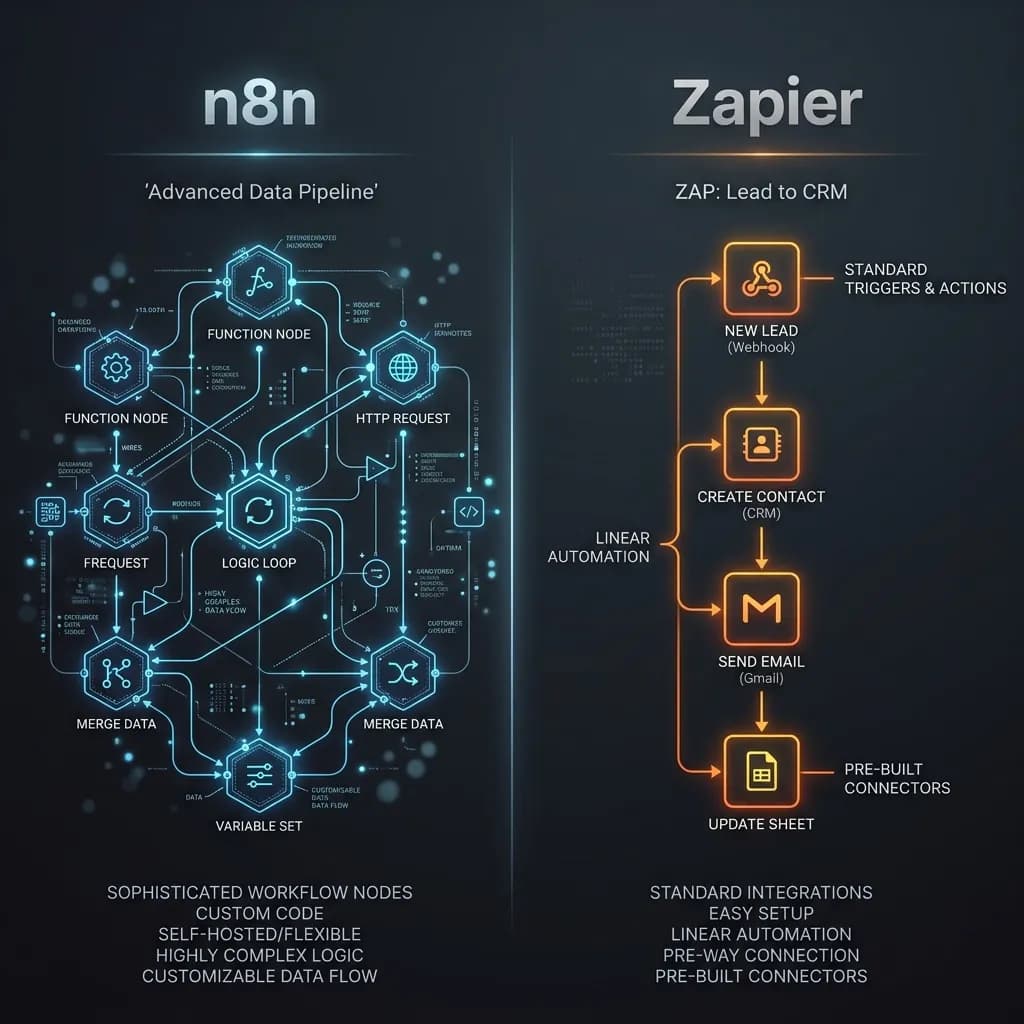
Most business automations are linear. A happens, then B, then C. And for many processes, that is enough. But real businesses are rarely linear. They have exceptions, conditions, specific rules for VIP clients, and logic that depends on context. And when a standard automation encounters that complexity, it simply does not know what to do.
The Limits of Out-of-the-Box Automations
Standard automation platforms work by connecting predefined actions. If you need something to change based on a contact's purchase history, or lead assignment to depend on complex criteria, predefined actions no longer suffice.
Companies that rely solely on predefined actions are limiting their automations to the lowest common denominator of what tool vendors decided to build. And that denominator rarely reflects the specific way your business operates.
The Advantage of Being Able to Insert Custom Logic
When a flow can include custom logic, the horizon of what is possible expands radically. You are no longer limited to connecting what exists: you can define exactly what should happen under every possible condition.
This translates into automations that truly reflect your operation: automatically calculating a quality score for each lead, deciding which advisor to assign based on workload and specialization, and formatting data exactly the way your CRM needs it.
The Business Results This Generates
Companies that implement automations with flexible logic do not just eliminate manual tasks — they build an operational advantage that is hard to replicate. We have seen concrete cases where this capability made a real difference. An agency that automated lead distribution based on historical close rates saw its conversion improve without changing anything else.
The Difference Between Automating and Optimizing
- A simple automation sends the same email to all new leads.
- An intelligent automation personalizes the email based on the lead's source, industry, and company size.
The impact on the prospect experience and conversion rate between those two approaches can be enormous.
Automation That Grows With You
Rigid automations become an operational glass ceiling. They work perfectly until your business evolves, and then they become a constraint. Automations with flexible logic are, by nature, more adaptable. You can modify the rules without redesigning the entire flow.
It is not just a technical tool. It is a strategic decision about whether you want your operation designed for today or for the business you want to be in two years.
Ready to scale?
Schedule a technical call to see how we can apply these strategies to your business.